
Pheasants International provides CAV and VAV system testing and balancing services in Pakistan for commercial buildings, hospitals, laboratories and industrial facilities.
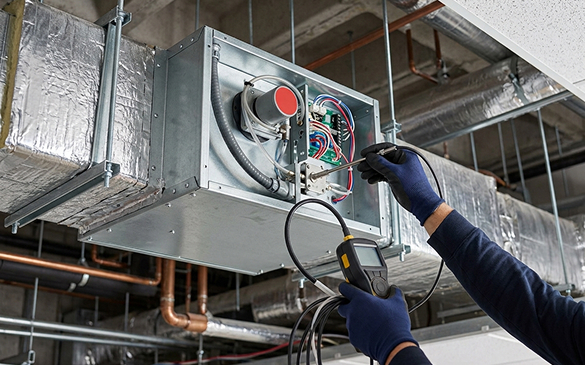
VAV system testing verifies that each variable air volume terminal delivers its design airflow at both maximum and minimum setpoints, that its controller and flow sensor are calibrated, and that system-level controls respond correctly across the full turndown range.
Variable air volume systems save energy on paper and lose it in the field. Boxes get commissioned to the wrong minimum. Controllers hold a static pressure setpoint far above what the system needs. The fan runs hard all day and the turndown the design promised never happens.
Box schedules, controller type, sequence of operation, design airflows
Every box at maximum and minimum setpoint
Flow sensor scaling and K-factors corrected against measurement
damper stroke, actuator travel and fail position
Fan airflow, static pressure, fan tracking, outside air across turndown
Static pressure reset strategy tuned to the most demanding box
BMS point-to-point verification and sequence confirmation
Terminal level
System level
Constant volume systems
Commercial office towers
Hospitals and clinics
Research and QC laboratories
Universities and educational buildings
Hotels
Government and institutional buildings
Data centers
Mixed-use developments
VAV system testing verifies that each variable air volume terminal delivers its design airflow at both maximum and minimum setpoints, that its controller and flow sensor are correctly calibrated, and that system-level controls respond correctly across the full turndown range.
Pheasants International provides CAV and VAV system testing and balancing across Pakistan, covering terminal verification, controller calibration and system-level control tuning.
A constant air volume system delivers fixed airflow and varies supply temperature to meet load. A variable air volume system holds supply temperature and varies airflow at each terminal. VAV saves fan energy but only if commissioned correctly.
Usually because the static pressure setpoint is too high, the sensor is badly located, or box minimums are set so high that no terminal ever closes. Testing and setpoint reset optimization typically corrects it.
Terminals can be measured and set manually, but the control sequences, reset strategy and fan tracking cannot be verified without the BMS. A complete result requires both.