

Pheasants International provides water balancing and hydronic balancing services in Pakistan for chilled water, condenser water and hot water systems.
Water balancing is the adjustment of flow rates through every coil, branch and riser so each receives its design flow, allowing coils to deliver rated capacity and pumps to run at their intended duty point.
Most chilled water systems in Pakistan move far more water than they need and still starve the coils at the far end of the riser. That is low delta-T: return water coming back 3 to 4°C warmer instead of 5 to 6°C. Pumps run continuously to compensate, and on current tariffs and generator hours you pay for it every operating hour.
Balancing corrects the distribution rather than the plant, which is why the fix is usually a fraction of the cost of the equipment it saves you from buying.
Piping schematics, pump curves, valve schedules and design flow rates
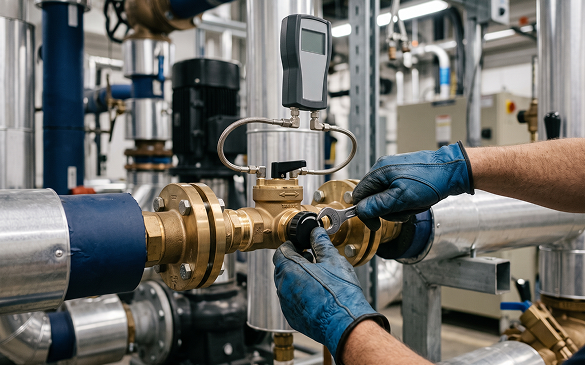
Measure existing flows, pump duty and delta-T across coils and plant
Identify starved circuits, passing valves, fouled coils and oversized pumps
Set circuits proportionally, branch by branch and riser by riser
Confirm coils achieve design temperature difference under load
Reduce VFD and differential pressure setpoints to the minimum that serves every circuit
Water balancing, also called hydronic balancing, is the adjustment of water flow rates through every coil, branch and terminal in a chilled water, condenser water or hot water system so each receives its design flow, allowing coils to deliver rated capacity and pumps to run at their intended duty point.
Pheasants International provides water balancing and hydronic balancing across Pakistan for chilled water, condenser water and hot water systems in commercial, industrial, healthcare and pharmaceutical facilities.
Common causes are over-pumping, passing or incorrectly set control valves, fouled coils, three-way valve bypass and unbalanced distribution that lets near circuits take more than their share of flow.
They describe the same work. Hydronic balancing is the common term in HVAC, while hydraulic balancing is used more often for heating systems, particularly in European practice.
Flows can be measured and reported using clamp-on ultrasonic instruments, but they cannot be set without adjustable devices. Where valves are absent we report flows and identify the locations where they should be installed.
Water first. Balancing air against a coil that is not receiving design water flow produces readings that will not hold once the hydronic side is corrected.
Duct leakage testing identifies air leakage in duct systems, improving HVAC efficiency and reducing energy loss.
Flow pattern testing uses smoke visualization to verify airflow direction and contamination control in cleanrooms and laboratories.