

Pheasants International provides HEPA filter integrity testing in Pakistan for pharmaceutical manufacturing, hospitals, laboratories and controlled environments.
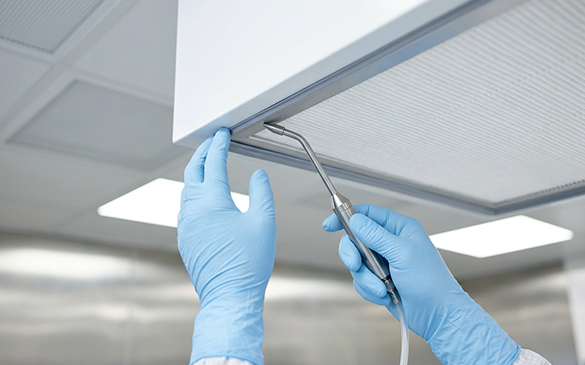
A HEPA filter integrity test introduces an aerosol challenge upstream of the installed filter and scans the downstream face, frame and gasket with a photometer probe to detect leaks that particle counting alone will not find.
A particle count tells you the room is clean at that moment. An integrity test tells you whether the filter, its seal and its housing are actually intact — which is what a regulator asks about at requalification.
Filter schedule, room classification, protocol and acceptance criteria
Airflow and system stability confirmed before challenge
PAO aerosol introduced upstream and concentration measured
Downstream face, frame and gasket scanned at controlled traverse rate
Leaks quantified against the acceptance threshold
Per-filter results, scan data, instrument calibration, certification status
Leakage rate, class achieved, pass or fail and marked-up drawings
Pharmaceutical manufacturing
Hospitals and operating theatres
Compounding pharmacies
Medical device production
Biotechnology laboratories
Electronics and semiconductor assembly
Food and beverage processing
Research facilities
A HEPA filter integrity test introduces an aerosol challenge upstream of an installed filter and scans the downstream face, frame and gasket with a photometer to detect leaks. It verifies the filter, its seal and its housing are intact, which particle counting alone cannot confirm.
Pheasants International provides HEPA filter integrity testing and cleanroom certification across Pakistan to ISO 14644-3 procedures for pharmaceutical, healthcare and laboratory facilities.
Typically every six to twelve months depending on room classification and your validation protocol, and always after filter replacement or any work affecting the ceiling grid or filter housing.
A particle count measures airborne particle concentration in the room at that moment. An integrity test verifies the filter and its seal are physically intact. Regulators generally expect both, because a room can pass a particle count with a leaking filter.
PAO is the most widely used challenge aerosol, with DOP used in some protocols. The aerosol is introduced upstream at a measured concentration and detected downstream by photometer.
Leaks within the limits permitted by the protocol may be repaired and the filter rescanned. Leaks beyond those limits require replacement and retesting. Both results are recorded in the report.