

Pheasants International provides HVAC energy audit services in Pakistan for commercial, industrial, healthcare and pharmaceutical facilities.
An energy audit is a systematic inspection, analysis and evaluation of energy flows within a facility, identifying where energy is consumed and which conservation measures will reduce it, with costed savings and payback.
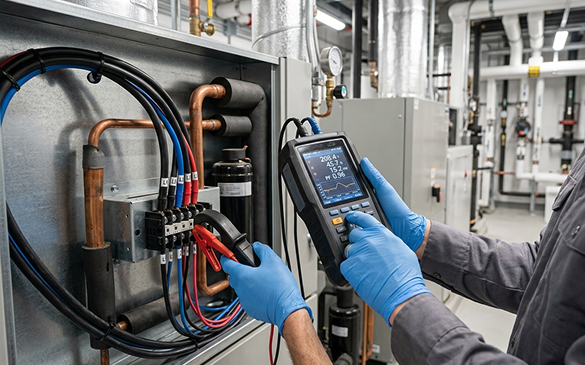
HVAC is usually the largest controllable cost a building has, and on current tariffs and generator hours it compounds fast. What separates our audits is measurement — because we are a testing and balancing contractor, we measure kW/TR at operating load and real pump duty against the curve rather than estimating from nameplate data.
Twelve months of utility data analyzed and normalized
Site walk-through, equipment inventory, operating hours confirmed
Chiller kW/TR, fan power against airflow, pump duty against curve, combustion efficiency
End-use energy breakdown against the metered baseline
Conservation measures costed with calculated savings and payback
Measures grouped no-cost, low-cost and capital, ranked by return
Post-implementation measurement to IPMVP where required
Level 1 — Walk-through
Utility bill analysis and benchmarking
Site survey and equipment inventory
Low-cost and no-cost measure identification
Order-of-magnitude savings estimate
Level 2 — Energy survey and engineering analysis
Detailed measurement and short-term metering
End-use energy breakdown
Chiller kW/TR at operating load
AHU and fan power versus airflow delivered
Pump power versus flow and head
Boiler combustion efficiency analysis
Power factor and demand profile review
Generator fuel consumption and load profile review
Schedules, setpoints and control effectiveness review
Fully costed measures with savings and payback
Level 3 — Detailed analysis
Calibrated energy modelling
Capital-intensive measure analysis
Investment-grade financial analysis
Measurement and verification plan
Commercial offices and towers
Textile and manufacturing plants
Hospitals
Hotels
Shopping malls
Pharmaceutical facilities
Food and beverage processing
Data centers
Universities and educational campuses
An HVAC energy audit measures how much energy a building’s heating, ventilation and air conditioning systems consume, establishes where that energy goes, and identifies costed conservation measures with calculated savings and payback, following the three levels defined in ASHRAE Standard 211.
Pheasants International provides ASHRAE Level 1, 2 and 3 HVAC energy audits across Pakistan for commercial, industrial, healthcare and pharmaceutical facilities, with measured chiller, fan and pump performance rather than nameplate estimates.
Level 1 is a walk-through with utility bill analysis and order-of-magnitude estimates. Level 2 adds detailed measurement, an end-use breakdown and fully costed measures with payback. Level 3 adds calibrated energy modelling and investment-grade financial analysis.
Twelve months of electricity and gas bills, generator fuel records where applicable, equipment schedules, as-built drawings if available, and operating hours.
It should. In Pakistan a facility’s real energy cost combines grid tariff and generator fuel, and measures that reduce peak demand during outage hours often carry the shortest payback.
Yes. Energy analysis supports several LEED and EDGE credits, and retro-commissioning is directly recognized in LEED for existing buildings.