

Pheasants International provides duct leakage testing services in Pakistan for commercial, industrial, healthcare and pharmaceutical projects.
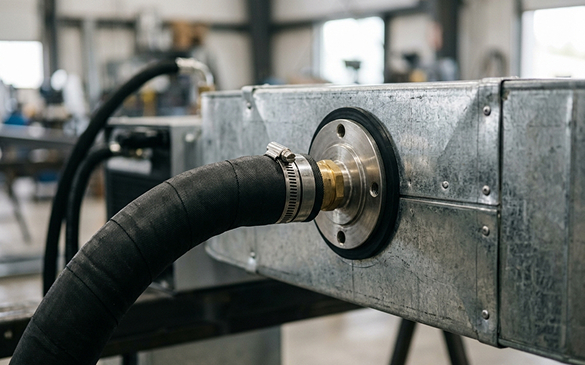
A duct leak test pressurizes an isolated section of ductwork with a calibrated fan and orifice, measures the airflow needed to hold that pressure, and compares the leakage rate against the class the specification demands.
Leakage is invisible on site and expensive for the life of the building. Air that escapes before the terminal was still paid for at the fan, and a system that cannot hold pressure will never balance to design.
Specification leakage class, test pressure and percentage of ductwork to be
Seal the section under test at every opening and branch
Bring the section to test pressure with a calibrated leakage rig
Record leakage airflow and calculate the rate against duct surface area
Trace and mark leakage points on failing sections
Verify sealed sections after remedial work
Leakage rate, class achieved, pass or fail and marked-up drawings
Pharmaceutical manufacturing
Hospitals and healthcare
Cleanrooms and controlled environments
Data centers
Commercial towers and offices
Hotels
Shopping malls
Industrial plants
Laboratories
A duct leak test pressurizes an installed section of ductwork to a specified test pressure and measures how much air escapes. The measured leakage is compared against the leakage class stated in the project specification to give a pass or fail result.
Pheasants International provides duct leakage testing across Pakistan to SMACNA, DW/144 and EN 12237 procedures for commercial, industrial, healthcare and pharmaceutical projects.
Before insulation is applied and before ceilings are closed, while joints remain accessible for sealing. Testing after enclosure turns a simple repair into a demolition exercise.
This is set by the specification. Many projects require a representative percentage of total duct area, with failure triggering testing of additional sections.
Leakage points are traced and marked, the contractor seals them, and the section is retested. Both the original and final results appear in the report.
Acceptable leakage is defined by the leakage class in your specification rather than a single universal figure. The class sets a maximum leakage per square metre of duct surface at a stated test pressure.